





























For most of its history, Bitcoin has been treated as digital gold. You buy it, you hold it, and you simply wait. That simplicity is part of Bitcoin’s appeal, but one also has to appreciate that it also comes with a limitation. Compared to other crypto ecosystems, Bitcoin has offered very few native ways to earn yield or unlock liquidity without giving up control.
In our introductory article about Babylon we explored how the project introduces Bitcoin native staking and security. As a continuation in this second part, we move one step further, as we look at how Babylon lays the groundwork for Bitcoin lending and borrowing, and why this could mark a real shift in how BTC is used inside decentralised finance.
In contrast to other projects, this is not about flashy yields or financial engineering, but it is about building financial primitives that respect Bitcoin’s core principles while finally expanding what BTC can do.

Why Bitcoin Lending and Borrowing Matters
Bitcoin is by far the largest and most valuable crypto asset in the world, and yet, for years its role has been very narrow. BTC has been excellent as a store of value, but it also proved to be much less useful as a financial asset.
The continuous success of Babylon, along with other BTCFi projects prove that many BTC holders want optionality. They want to earn yield, access liquidity, or put their capital to work without selling their Bitcoin. Historically, doing this meant making uncomfortable tradeoffs. Centralised platforms required users to hand over custody and, for many BTC holders, this felt like a growing contradiction with Bitcoin’s emphasis on self custody and decentralisation, especially after repeated platform failures exposed the risks involved. Furthermore, DeFi solutions relied on wrapped Bitcoin, which introduced bridge risk, smart contract risk, and dependency on other chains.
These approaches worked, until they did not, as custodial failures and bridge exploits made one thing very clear. Bitcoin holders value security and self custody more than headline yields.
This is where Bitcoin native lending and borrowing truly starts to matter. If BTC can be used in financial contracts without leaving the Bitcoin security model, it becomes far more than a passive asset.
It becomes productive capital, without asking users to compromise on trust.
What Is Babylon? A Quick Recap
Babylon is a protocol designed to extend Bitcoin’s security into the wider decentralised economy. At its core, it allows BTC to be used as economic security for other networks, without wrapping, bridging, or transferring Bitcoin to another chain. Instead of moving BTC, Babylon uses Bitcoin native mechanisms such as time locks and cryptographic conditions to make BTC slashable under predefined rules. This creates real economic guarantees while keeping BTC on Bitcoin.
It is worth noting that Babylon positions itself as an infrastructure project rather than an application. It provides the security and settlement layer that other systems can build on, including staking, coordination, and eventually financial applications like lending and borrowing.
We highly encourage you to dive deeper into our “Introduction to Babylon” article if you want a broader overview of the network and its role in BTCFi by clicking here. Additionally, if you wish to explore further the broader BTCFi ecosystem read our “Introduction to BTCFi” here.
How Babylon Enables BTC Lending and Borrowing
To understand Bitcoin lending through Babylon, it helps to think in terms of foundations rather than finished products. In plain english, it is better to think of Babylon as infrastructure that enables lending and borrowing rather than a finished product.
To better understand BTC lending and borrowing, let’s understand how lending works within traditional finance.
First of all, traditional lending requires enforcement, which basically means that if someone borrows and does not repay, there must be consequences. In most crypto systems, this enforcement is handled by smart contracts holding collateral on-chain, but for Bitcoin, this has always been difficult without wrapping BTC or using custodians.
Babylon takes a different approach. It uses Bitcoin native mechanisms, such as time locks and slashing conditions, to lock BTC in place as security, while it remains on the Bitcoin network. If predefined rules are broken, that BTC can be penalised by the protocol. This is critical for lending and borrowing as essentially it means that BTC can back financial agreements without being transferred to another chain or contract. In simple terms, Babylon allows Bitcoin to be used as secure backing for financial agreements, without moving it off the Bitcoin network.
Bitcoin Lending Through Babylon
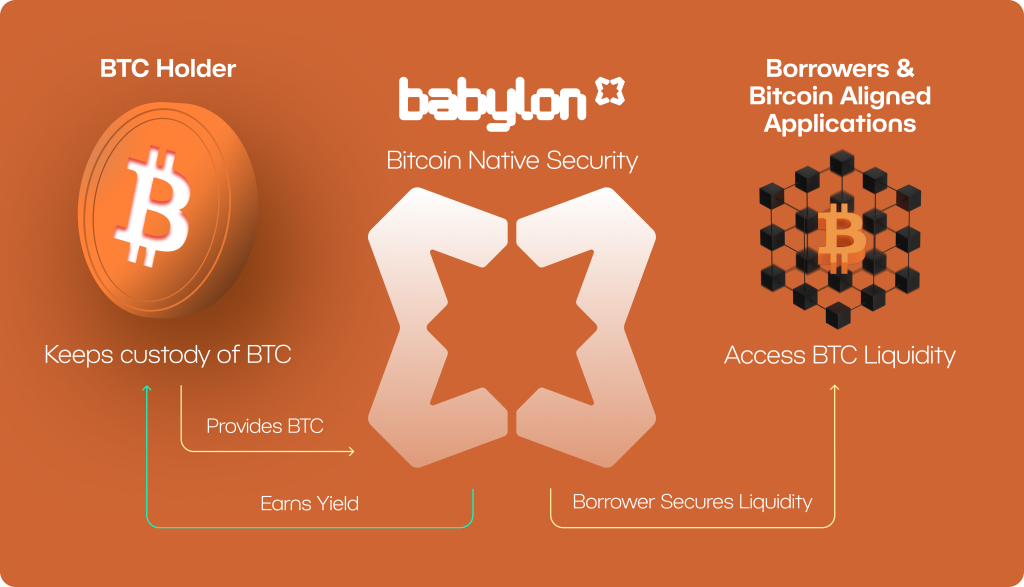
In a Babylon enabled world, Bitcoin lending looks very different from what we have seen before.
Instead of depositing BTC into a custodial platform or converting it into a wrapped token, lenders commit BTC through Bitcoin native mechanisms, and in turn that BTC becomes economic security for the system, while lenders earn yield in return.
Who borrows BTC in this model? Borrowers are typically participants who need Bitcoin liquidity for operational or financial reasons, without wanting to permanently acquire BTC on the open market. For example, this could include networks, applications, or market participants operating within Bitcoin aligned ecosystems.
What is very important to note here is that yield does not come from leverage games. It comes from real demand for Bitcoin backed security and liquidity, while risk is managed through protocol enforced rules, including slashing conditions that penalise misbehaviour.
For BTC holders, the key shift is philosophical as Bitcoin is no longer just idle capital. It becomes productive while remaining anchored to Bitcoin’s security assumptions.
Bitcoin Borrowing Through Babylon
Borrowing Bitcoin is often overlooked, but it plays an important role in mature financial systems. There are many reasons someone may want to borrow BTC. They may need short term liquidity, want exposure to Bitcoin without immediate purchase, or need BTC to participate in Bitcoin native systems.
Babylon enables borrowing models where collateralisation and enforcement are grounded in Bitcoin security rather than external chains. Collateral requirements, interest rates, and incentives can be designed with Bitcoin native guarantees in mind. In practice, this reduces reliance on trusted intermediaries and synthetic assets, while at the same time, borrowers interact with systems that are transparent, rule based, and secured by Bitcoin itself.
As with lending, these systems are still emerging, but the key point is that Babylon makes Bitcoin borrowing possible without breaking Bitcoin’s trust model.
Babylon vs Traditional BTC Lending Platforms
To understand why Babylon matters, it helps to compare it with what came before.
Centralised BTC lenders offer simplicity, but at a huge cost. Users give up custody and trust the platform to manage funds responsibly, and history has shown us time and time again how fragile this model can be. Wrapped Bitcoin in DeFi offers programmability, but introduces bridge risk and dependency on other ecosystems, and we also know that bridges can fail.
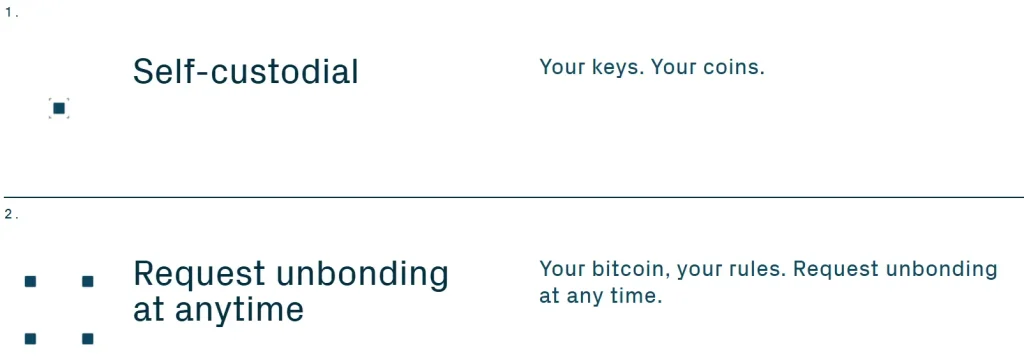
Babylon takes a different path. BTC stays on Bitcoin. Custody remains with the user, and security is enforced through cryptographic rules rather than intermediaries.
Key Benefits of Babylon’s BTC Lending Model
By far, the most important benefit is alignment with Bitcoin’s core principles. Babylon does not ask users to trust a company, a multisig, or a bridge, as there is no asset wrapping and there are no synthetic representations of BTC. Everything is anchored to Bitcoin’s base layer.
Trust is not removed entirely, but it is reduced and made clear. Users can see where trust is required and judge the risks for themselves, while yield is framed as a byproduct of real economic activity rather than financial engineering.
For Bitcoin holders who value security first and optionality second, this model may well feel like a natural evolution.
Risks and Considerations
As with everything within this space, no system is risk free, and Babylon is no exception. Smart contract and protocol risks are present in any complex cryptographic system, while at the same time there is also adoption risk. New financial primitives simply take time to gain liquidity and user trust. Furthermore, early stage lending markets may be shallow, and incentives may evolve as the ecosystem matures, and additionally, users should understand that this is infrastructure in progress, not a finished product.
The upside to all of this is that these risks are openly discussed and designed around, rather than hidden behind convenience.
What This Means for Bitcoin’s Future
Babylon represents a shift in how Bitcoin can participate in decentralised finance. Instead of copying Ethereum style DeFi, Babylon takes a Bitcoin first approach and it extends Bitcoin’s strengths rather than working around its limitations.
If successful, this could unlock an entire class of Bitcoin native financial activity. Lending, borrowing, and yield become possible without undermining Bitcoin’s security model. For BTC holders, this means more choice. For the broader ecosystem, it means Bitcoin can act as both a store of value and a financial backbone.
Final Thoughts
Bitcoin lending and borrowing has always existed, but rarely in a way that felt truly aligned with Bitcoin itself. Babylon does not promise instant yield or effortless returns but what it offers is more important. The project provides the foundations for Bitcoin native financial primitives that respect security, self custody, and long term thinking.
This is not a shortcut. It is a structural change and for Bitcoin, that may be very well exactly what is needed.
If you are interested in participating in Babylon’s protocol by staking BABY, we encourage you to have a look at our BABY staking dashboard, while if you want to stay up to date with the latest research, insights, and BTCFi developments, follow Simply Staking on X and keep learning as this new era of Bitcoin finance unfolds.