


























If you believe that faster blockchains must always compromise on security or decentralisation, the Conflux Network is here to challenge that assumption.
Many blockchain platforms promise scalability, but few redesign their foundations to actually achieve it. Instead of forcing transactions into a single line, Conflux allows blocks to be processed in parallel, while still preserving a secure and decentralised consensus model. The result is a blockchain designed for high throughput, low fees, and cross chain interaction without weakening security or compromising on decentralisation.
Considering all of this, it is only natural to dedicate an article to Conflux, breaking down its architecture in a clear and simple terms. Furthermore, we explain how the Conflux Network works, what makes its consensus model different, what the CFX token is used for, and how users should think about the platform as beginners.
The Problem the Conflux Blockchain is Designed to Solve

Most blockchains process blocks one after another, but for the most part this sequential design limits scalability. For example, when user activity increases on a traditional blockchain, transactions start to compete for block space, which in turn would result in an increase in transaction fees, and confirmation times slow down. If you ever tried to make use of a dApp during times like these, all this friction becomes very evident very quickly.
At the same time, modern crypto applications rarely live on a single chain. Assets move across networks, decentralised applications integrate multiple protocols, and therefore users started to expect smooth cross chain interaction. Therefore, it is fair to assume that in today’s crypto landscape, scalability alone is not enough, and it is expected that a blockchain has to integrate with broader ecosystems.
Well, the Conflux Network was built to address both problems. It focuses on scalability and interoperability, while preserving decentralisation at the protocol level, rather than relying entirely on external layers or off-chain workarounds.
What is the Conflux Network
Conflux Network is a public blockchain platform designed to support high transaction throughput while remaining secure and decentralised. The network is able to achieve this by combining a novel consensus structure, a hybrid proof-of-work (PoW) and proof-of-stake (PoS) model, and a multi-environment architecture. Furthermore, Conflux is also known for its regulatory compliant positioning in China, which has influenced its emphasis on infrastructure, research, and long term sustainability.
For developers and users, Conflux provides a scalable blockchain that can integrate with existing crypto tooling while continuing to experiment with new protocol level ideas.
Tree Graph Consensus and Parallel Processing of Blocks
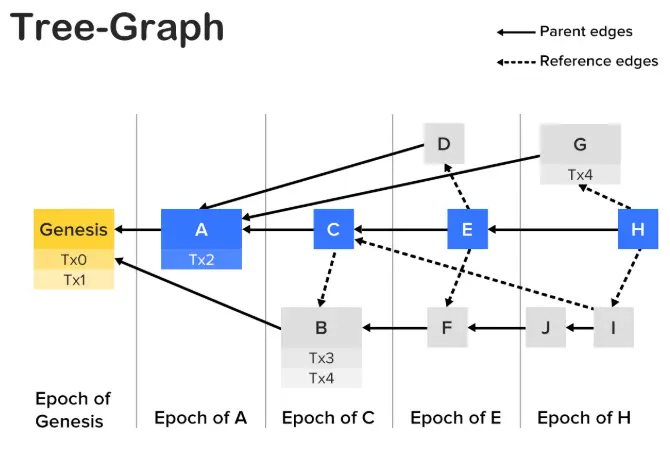
At the heart of the Conflux protocol is the Tree Graph consensus algorithm. Considering the importance, let’s invest some time to understand how this works.
First of all, it should be pointed out that traditional blockchains discard blocks that arrive at the same time, but Conflux does not. Instead, it organises concurrent blocks into a tree like graph structure, allowing the parallel processing of blocks and transactions. These blocks are later ordered using a deterministic rule set so that all nodes agree on the same transaction history.
This approach allows Conflux to scale throughput by increasing block production rather than restricting it. This means that the network can process many blocks at once, improving transactions per second while maintaining decentralisation and attack protection.
What does this mean for users?In practice, most users do not need to worry about the technical details. What matters is the result. The Conflux blockchain is built to stay fast and reliable even when activity increases, without depending on centralised systems or special privileges.
Hybrid Consensus Combining Proof-of-work and Proof-of-Stake
As mentioned before, Conflux uses a hybrid consensus model. But how does this work?
Fundamentally, proof-of-work is used for block production and miner participation, which in practice anchors the network in a security model that has been widely tested across crypto networks. On the other hand, proof-of-stake is layered on top to provide finality, which reduces uncertainty about how and when transactions become irreversible.
This combination allows Conflux to remain secure while improving settlement confidence. What is the key takeaway from all of this? The most important thing to understand is that Conflux does not abandon proven security assumptions in the pursuit of scalability!
Core Space and eSpace on the Conflux Platform
The Conflux platform runs across two distinct but connected environments. The first one is called Core Space and it is the native environment where Conflux’s Tree Graph consensus and core protocol features operate. eSpace is the second environment and it is an Ethereum compatible environment that supports the Ethereum Virtual Machine, making it easier for existing decentralised applications, wallets, and developer tools to integrate with the Conflux Network.
These two environments are connected through native cross space interaction. In practice, this allows developers to build decentralised applications that take advantage of Conflux’s scalability while still using familiar Ethereum tools and infrastructure. On the other hand, for users, this means familiar wallets, lower fees, and smoother integration across the multi chain ecosystem.
Tokenomics: The CFX Token Utility, Distribution and Vesting Explained
CFX is the native token of the Conflux Network and plays a central role in how the blockchain operates, secures itself, and funds long term growth. The token is not just a payment token but it also acts as a core coordination mechanism at the protocol level. Let’s break down the most important information there is to know about CFX.
First of all, it should be noted that each CFX token is divisible into smaller units called “drips”, where 1 CFX equals 1018 drips. What this means in practice is that the token allows the network to handle transaction fees, staking rewards, and storage costs with high precision.
One of the primary uses of CFX is to pay transaction fees. Every transfer or smart contract interaction on the Conflux Network requires CFX to cover computational costs, and these fees are paid to miners who produce blocks through proof-of-work. CFX also underpins Conflux’s on-chain storage model. When users or decentralised applications consume storage, they must lock CFX as collateral through a storage rent mechanism. This design discourages unnecessary data accumulation and ensures that storage is treated as an economically priced resource rather than a free and permanent one. When storage is released, the locked CFX can be returned to the user or decentralised application.
Staking is another very important key utility. While Conflux relies on proof-of-work for block production, it uses proof-of-stake to provide finality. Users who stake CFX help secure this finality layer and earn staking rewards in return. Furthermore, CFX also enables participation in governance, allowing token holders to take part in protocol level decision making as the network evolves.
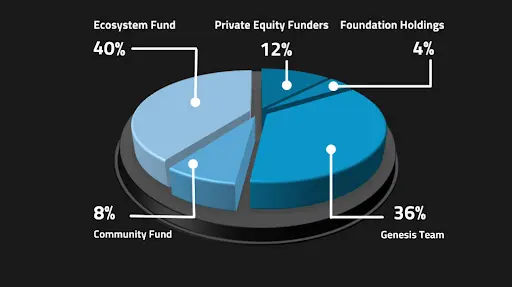
At genesis, the Conflux Network included a pre- mined allocation of 5 billion CFX tokens. These tokens were assigned to defined categories and released over time through vesting schedules rather than entering circulation immediately.
The initial token distribution was structured as follows. First of all, private equity funders received 12% of the genesis supply, released over 2 years. Foundation holdings accounted for 4% plus any unsold private allocation tokens, unlocked monthly also over a period of 2 years, while the genesis team received 36%, vested over 4 years. Furthermore, a community fund received 8% while an ecosystem fund received 40% of the genesis tokens, both of which unlock within 4 years.
On the other hand, mining rewards follow a separate issuance path, with CFX entering circulation gradually as blocks are produced. For users and stakers, this means CFX supply growth is structured, predictable, and closely tied to long term network participation rather than short term release events.
Cross chain connectivity and ShuttleFlow
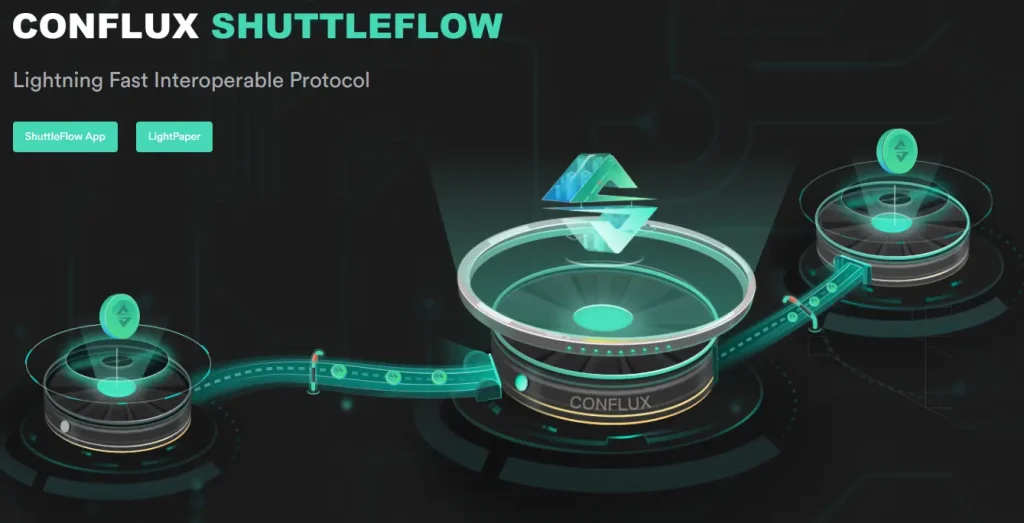
Interoperability is a core focus of the Conflux Network, so much so that the project has its own cross-chain bridge called ShuttleFlow which enables assets to move between Conflux and other blockchains. This bridge is important as it allows decentralised applications on Conflux to access liquidity and users from outside the native ecosystem while expanding visibility and usability for dApps built on the platform, while at the same time reinforcing Conflux’s goal of supporting a borderless blockchain economy.
The Conflux Roadmap and ongoing research
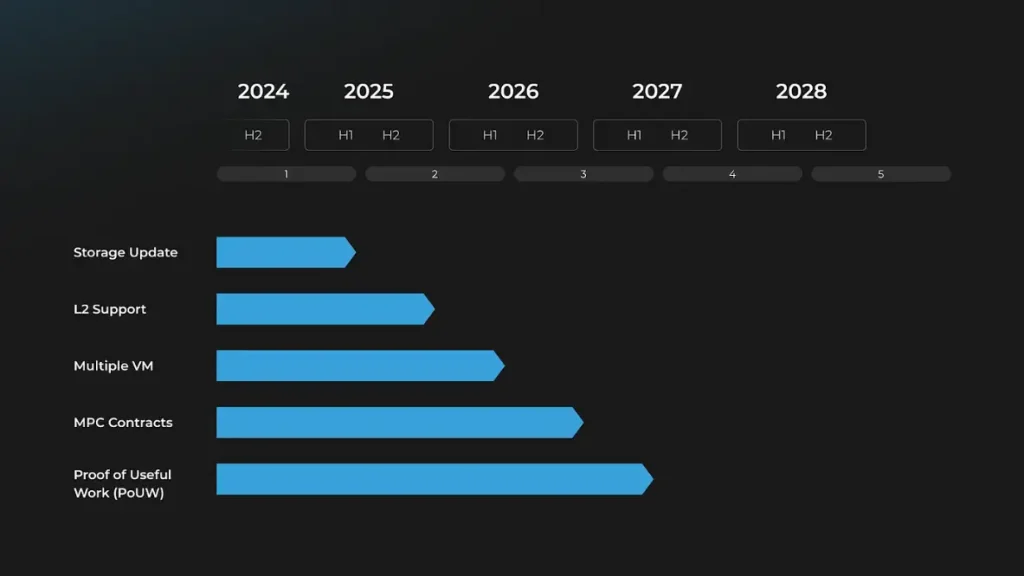
Upon reviewing Conflux’s roadmap it becomes apparent very quickly the projects focus on investing heavily in research and development. Its roadmap includes advanced authenticated storage to improve input output performance, expanded layer 2 and rollup integration, support for multiple virtual machines, and privacy focused execution using multi party computation.
One long term research direction is proof-of-useful work, which explores how proof-of-work could support tasks beyond hashing, such as scientific computation, while still securing the network. All of these initiatives reflect a long term protocol driven approach to scalability rather than short term optimisation.For readers interested in how zero knowledge technology fits into this broader scaling landscape, Simply Staking has published an accessible article explaining Why Starknet Matters for Ethereum. It provides helpful context for understanding rollups and zero knowledge proofs as part of modern blockchain design.