
















Stating that Chainlink is a foundational part of today’s blockchain infrastructure is probably an understatement. Rather than being a single application or just a token driven platform, Chainlink provides oracle services, data feeds, automation, and cross chain connectivity that allow decentralised applications to function reliably.
As Chainlink’s ecosystem has evolved over the years, so too has its approach to community participation, and Chainlink Rewards Season 1 represents the latest step in that evolution. It is a community engagement and rewards program that enables Chainlink Build projects to make their native tokens claimable by eligible LINK stakers and other participants within the Chainlink ecosystem.
But before diving deeper to explore how Chainlink Rewards Season 1 works, it is important to first give a quick overview and understand what Chainlink is and why staking plays such a central role in helping secure the Chainlink network.
What Is Chainlink and Why It Matters to the Chainlink Ecosystem
Chainlink is a decentralised oracle network that connects smart contracts with real world data, external systems, and other blockchains. Blockchains are inherently isolated environments and Chainlink solves this limitation by delivering tamper resistant data and secure connectivity that smart contracts can rely on. Putting it in simpler terms, think of a Blockchain as an isolated island. In order for information to arrive on this island, connectivity is needed through airplanes or boats. Within this analogy, Chainlink represents not just the means of connectivity, but a network of trusted couriers that verify, aggregate, and securely deliver information so the island can rely on it.
This infrastructure underpins a wide range of use cases across decentralised finance, tokenised assets, cross chain applications, and on-chain automation. In this sense, Chainlink functions as shared infrastructure rather than a standalone application, supporting thousands of projects across the broader Chainlink ecosystem.
Staking LINK is one of the ways participants contribute to this infrastructure. By staking, participants help secure oracle services and strengthen the economic guarantees that underpin Chainlink data feeds and other services.
For readers interested in staking LINK or understanding how staking activity supports the Chainlink ecosystem, Simply Staking’s Chainlink staking dashboard provides a clear network level view of staking participation, metrics, and validator activity in one place. Click here to explore it! For readers who would like a step-by-step explanation of how to manage and stake LINK using this dashboard, Simply Staking’s Chainlink staking guide walks through the process, explains the underlying mechanics, and outlines how staking has evolved within the Chainlink ecosystem. We invite you to click here to read further if interested.
How Staking LINK Helps Secure the Chainlink Network
Staking within Chainlink is designed to align incentives between node operators, token holders, and the protocols that depend on Chainlink services. Rather than focusing purely on short term rewards, Chainlink staking is positioned as a mechanism for accountability and long term reliability.
Historical participation in Chainlink staking, including participation in Chainlink staking v0.1 and v0.2, forms part of the broader Chainlink economics initiative. This historical context matters because Chainlink Rewards builds on past participation rather than replacing staking itself. Therefore, by recognising long term stakers, Chainlink creates a pathway for deeper engagement between the Chainlink community and the projects building on its infrastructure.
What Is Chainlink Rewards Season 1
Essentially, Chainlink Rewards Season 1 is an evolution of the Chainlink Rewards program. It is a community engagement and rewards program that enables Chainlink Build projects to make their native tokens claimable by Chainlink ecosystem participants, including eligible LINK stakers.
One of the most important things to note is that these tokens are distributed by Build projects, not by Chainlink itself. Projects participating in the Chainlink Build program commit a portion of their token supply to the ecosystem and in exchange, they receive enhanced access to Chainlink services, technical support, and collaboration as part of the Chainlink Build initiative.
It is best to think of Chainlink Rewards as an engagement mechanism rather than a yield product. Additionally, one should also note that participation is subject to eligibility criteria, snapshot timing, and regional availability, as the rewards program is being built with regulatory considerations in mind.
From Season Genesis to Chainlink Rewards Season 1
Chainlink Rewards Season Genesis marked the initial launch of the rewards framework as it introduced the core idea of native tokens being made claimable by the Chainlink ecosystem through participation rather than speculation.
Chainlink Rewards Season 1 expands this model significantly. Season 1 features 9 Build projects and introduces a more advanced engagement and claiming mechanism. Instead of just receiving a static allocation, participants actively decide how to allocate their participation across multiple projects. This marks a very important evolution of the Chainlink Build ecosystem and reflects a broader shift towards informed and deliberate community engagement.
How Chainlink Rewards Season 1 Works
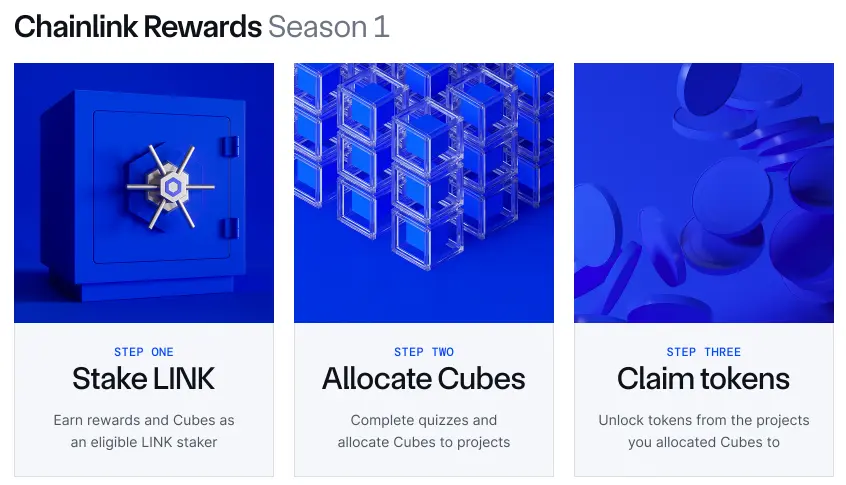
Let’s now invest some time to understand how all this works! Chainlink Rewards Season 1 follows a structured process that includes Cubes, allocation, and claiming.
Cubes and historical participation in Chainlink staking
First of all, Cubes are a non-monetary unit of account used exclusively within Chainlink Rewards Season 1 and they are not transferable and cannot be traded. Essentially, Cubes exist solely to determine how native tokens from Build projects can be redeemed for token rewards.
Cubes balances for Season 1 are based on historical participation in Chainlink staking v0.1 and v0.2, taking into account factors such as the amount of LINK staked and the duration of participation. Furthermore, cubes do not increase during the season and expire at the end of the allocation period.
It should be noted that the snapshot used for determining Cubes balances for Season 1 was taken on November 3.
Allocating Cubes to Build projects
During the allocation period, LINK stakers can begin allocating Cubes to projects made available in Season 1, but before allocating to a Build project, participants must review the project and complete a short quiz, reinforcing education and informed decision making.
Allocations are flexible and can be adjusted throughout the allocation window. All allocation activity happens off-chain, meaning there are no transaction fees associated with reallocating Cubes. Each Build project has a fixed pool of tokens for Season 1. The number of tokens a participant can claim from a Build project is proportional to the share of Cubes allocated to that project relative to the total Cubes allocated.
Claiming native tokens in Season 1
After the allocation period ends, participants who allocated Cubes can claim tokens from each Build project they supported. Tokens unlock linearly over ninety days, and participants may claim as tokens unlock or wait until the full unlock period is complete.
The allocation equals 1 to 1 proportionality. If a participant allocated 1 percent of the Cubes to a project, they are entitled to 1 percent of that project’s fixed pool of tokens for Season 1.
Early Unlock and the Loyalty Pool
Chainlink Rewards Season 1 introduces an Early Unlock option. In practice, this allows participants to claim a portion of still locked tokens before the full unlock period has completed, while forfeiting the remaining locked amount. It is important to note that in such cases, tokens that have already been unlocked are not forfeited.
On the other hand, any forfeited tokens flow into a Loyalty Pool. At the end of the unlock period, the Loyalty Pool is distributed among participants who did not choose Early Unlock, based on their Cube allocations. This mechanism creates a clear trade off between early access and long term participation and is presented as a design feature rather than a recommendation.
The Nine Build Projects in Chainlink Rewards Season 1
Season 1 features nine Build projects participating in the Chainlink Build program:
These Build projects span areas such as decentralised finance, cross chain infrastructure, tokenisation, cryptographic privacy, and data analytics. Each project integrates Chainlink services, including Chainlink data feeds, automation, cross chain communication, or verifiable randomness, as described in the official announcement.
If you would like to dive deeper into specific Build projects, Simply Staking has dedicated articles exploring both Space and Time and Truflation in more detail.
Why Chainlink Rewards Season 1 Matters
Chainlink Rewards Season 1 represents an evolution of the Chainlink ecosystem by providing enhanced engagement and connection between the Chainlink community and Build projects. Rather than just distributing tokens passively, the rewards program encourages research, education, and active participation. It aligns long term stakers with the projects building on Chainlink infrastructure and strengthens the economic relationships that support Chainlink services. One may say that this approach truly reflects the broader direction of Chainlink economics and the continued maturation of its ecosystem.
What Eligible LINK Stakers Should Keep in Mind
First of all one should keep in mind that Chainlink Rewards Season 1 is not a guarantee of returns. Cubes are not assets, and rewards depend on historical participation, allocation decisions, and fixed project token pools. Furthermore, availability is subject to jurisdiction and timelines, and mechanics may evolve over time.
Additionally LINK stakers should always keep in mind that understanding how the rewards program works is more important than focusing on outcomes.
Final Thoughts and Next Steps
Chainlink Rewards Season 1 offers eligible LINK stakers a structured way to engage directly with Build projects through a transparent and participation driven framework. It reflects the evolution of the Chainlink ecosystem from pure infrastructure to a more connected and collaborative network.
To stay informed on Chainlink, staking, and broader ecosystem developments, follow Simply Staking on X for ongoing research and updates while for those readers who want to explore the official details in full, you can read the original announcement directly from Chainlink here.