
































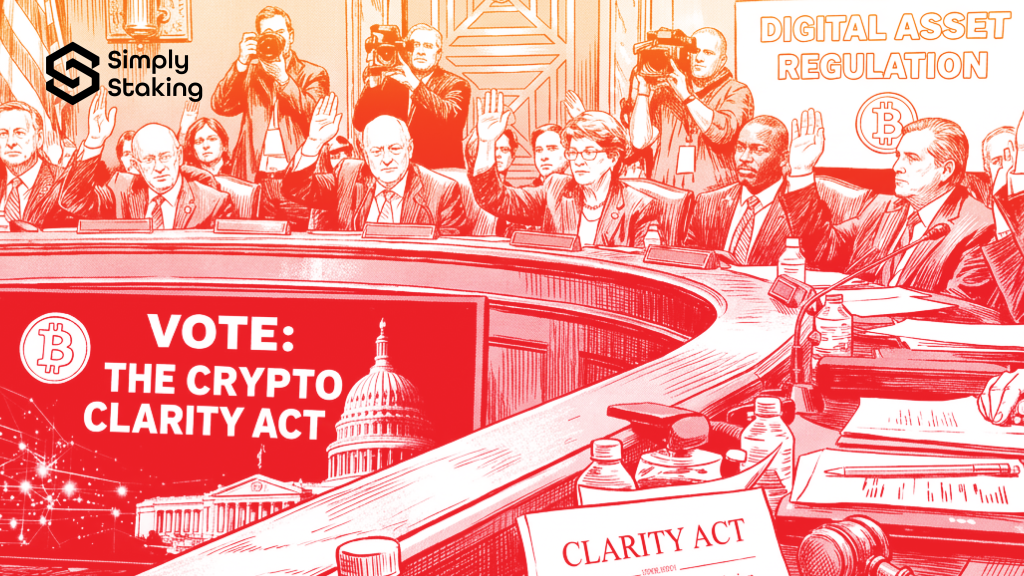
CLARITY Act crypto developments have moved forward in the US Senate, but the bill is not law yet. Officially known as the Digital Asset Market Clarity Act of 2025, the proposed US market structure bill that aims to create clearer rules for digital asset markets.
Therefore, the question to ask is: What impact will this bill have on infrastructure teams if passed by the US Senate?
For infrastructure teams, the issue is not that the bill changes blockchains directly, as it does not aim to rewrite consensus, RPC methods or node software. The consequences of this are indirect, as we have to consider what clearer market rules could mean for infrastructure demand, data access, uptime expectations and compliance workflows
What is the CLARITY Act Crypto Bill?
The Digital Asset Market Clarity Act of 2025 is a US crypto market structure bill. It is designed to clarify how digital assets are treated under US-market regulation, especially where Securities and Exchange Commission (SEC) and Commodity Futures Trading Commission (CFTC) responsibilities overlap.
Effectively, if enacted, it would shape how certain market participants handle disclosures, customer protection, risk controls and compliance obligations. Therefore, for Web3 teams, the practical reading is this: legal clarity can change behaviour around the chain, even when it does not change the chain itself.
What changed recently with the CLARITY Act?
On the 12th of May 2026, Senate Banking Committee Chairman Tim Scott, Senator Cynthia Lummis and Senator Thom Tillis released updated market structure bill text ahead of the committee markup. The committee said the text followed months of talks with lawmakers, regulators, law enforcement, financial institutions, innovators and consumer advocates.
Moreover, on the 14th of May 2026, the Senate Banking Committee said it had advanced the CLARITY Act by a 15 to 9 vote, and stated that H.R. 3633 moved out of committee and to the Senate floor.
It should be made clear that although this is significant progress, it is not a final passage. The CLARITY Act still needs further Senate action, and the final text could change before any law is enacted.
Why the Senate Agriculture track matters

One important point to address is that the CLARITY Act is not moving through the Senate in isolation, as a separate Senate Agriculture Committee track is also relevant because that committee oversees the CFTC.
That matters because the CFTC is expected to play a major role in any US framework for digital commodities. In simple terms, the Banking Committee track focuses heavily on securities law questions and market structure, while the Agriculture Committee track is important for commodity market oversight.
On the 29th of January 2026, the committee said it had advanced the Digital Commodity Intermediaries Act. According to the committee, the legislation would give the CFTC new authority to regulate digital commodities and strengthen consumer protections in that market.
This matters because market structure is split across more than one committee path. A final framework may depend on how the Banking and Agriculture approaches are reconciled, especially around digital commodities, intermediaries and agency authority.
What the CLARITY Act is trying to solve
The bill is trying to reduce uncertainty around digital asset market oversight. Supporters argue that current US rules leave too much room for dispute over when an asset or activity falls under securities law, commodities law or another regulatory route.
The Senate Banking Committee says the bill addresses areas such as anti-fraud authority, disclosures, customer protection, intermediary obligations and illicit finance controls. Its own fact sheet refers to CLARITY Act consumer protection and illicit finance provisions, including sanctions compliance, suspicious activity monitoring and customer identification requirements for certain intermediaries.
This is where infrastructure becomes part of the conversation. Once firms have clearer obligations, they need systems that can support those obligations. That means access to current data, historical records, transaction context and operational evidence.
Why CLARITY Act Crypto Developments Matter for Blockchain Infrastructure
Any infrastructure impact from these developments would be indirect. Still, indirect does not mean irrelevant.
The hope is that clearer rules would bring more regulated activity into digital-asset markets, and therefore firms will need dependable ways to read from and write to networks. They will also need stable access across chains, better observability and cleaner records of what happened on-chain.
For a small test app, RPC lag is annoying, but for bigger players such as exchanges, custodians, wallets, market makers or compliance desks, poor chain access can affect balances, transaction status, dashboards, reporting and investigations.
That is why reliable RPC access becomes a business issue. A regulated workflow needs more than a live endpoint. Fundamentally, it needs confidence that the data is current, the request path is healthy and failures are visible.
What the CLARITY Act Does Not Do
Let’s now spend some time analyzinganaylsing the limitations of the CLARITY Act. The main points to currently understand are:
- The bill is not law yet. It has moved forward in the Senate process, but it still needs further action before it can take effect.
- It does not change how blockchains work. Consensus rules, validator behaviour, node clients and RPC methods would remain technical matters.
- It does not make every token compliant. Token classification, disclosures, market activity and intermediary roles would still need to be reviewed carefully.
- It does not remove all legal uncertainty. Future agency rules, enforcement decisions and court interpretation could still shape how the framework works in practice.
- It does not treat every wallet, node operator or developer in the same way. DeFi, non custodial development and software interfaces remain areas to watch closely.
- • It does not replace technical due diligence. Clearer rules would not fix weak monitoring, poor failover design, stale data issues or unreliable data pipelines.
Risks and Unresolved Concerns
It is true that the bill has support, but it also has critics.
During the Senate Banking markup, Senator Elizabeth Warren raised concerns raised during the Senate Banking markup around investor protection, illicit finance, national security, financial stability, state level protections and ethics.
It is important that those concerns should not be dismissed as background noise. Crypto market structure is also about fraud, custody failures, sanctions risk, market abuse and consumer harm, and therefore, a clearer framework still needs to deal with those issues.
Furthermore, hard questions remain around DeFi compliance, decentralisation, custody, intermediaries and enforcement. For example:
- When is software just software?
- When does an interface become an intermediary?
- What data should regulated firms collect when users interact with public chains?
- How should cross chain activity, bridges and mixers be handled?
A bill can clarify some issues while leaving others to regulators and courts.
What Web3 Teams Should Watch Next
Web3 teams should watch whether the bill reaches the Senate floor and whether the text changes before any vote.
Additionally, they should be tracking how the Banking and Agriculture approaches are reconciled. Ultimately, the final division of SEC and CFTC responsibilities will matter for exchanges, brokers, dealers, custodians, DeFi interfaces and market data systems.
The treatment of digital commodity intermediaries is especially relevant. If obligations become clearer, firms will need systems that support reporting, monitoring, customer protection and risk management.
Non-custodial development also needs close attention. The committee materials describe support for lawful software development, but the details matter. Infrastructure teams should read future versions with care, especially where interfaces, routing, data-access and operational control are involved.
Furthermore, it should be made clear that future rulemaking may be as important as the statute itself, as agencies could add detailed requirements around disclosures, surveillance, custody, cybersecurity, market integrity and operational controls.
The better question to ask is not only who regulates the asset, but it is what data users will need, how reliable access must be and what happens when the infrastructure fails.

The CLARITY Act is a legal development, but its effects will not stop at legal teams.
If digital asset markets become more structured, the systems underneath them need to be more reliable, observable and scalable. Clearer rules have the potential to increase expectations around data-access, transaction monitoring, audit trails and operational resilience.
That does not mean regulation improves infrastructure by itself, but it means that poor infrastructure becomes harder to ignore when blockchain activity supports regulated financial workflows.
Regulatory clarity does not reduce the need for strong infrastructure. Quite the contrary. In many cases, it makes the quality of that infrastructure more visible.
Frequently Asked Quetions
What is the CLARITY Act crypto bill?
The CLARITY Act, formally the Digital Asset Market Clarity Act of 2025, is a US crypto market structure bill. It aims to clarify how digital assets and certain intermediaries are treated under US market regulation.
Has the CLARITY Act passed?
No. The CLARITY Act has advanced out of the Senate Banking Committee, but it is not law yet. It still requires further Senate action and could change before enactment.
How could the CLARITY Act affect blockchain infrastructure?
The effect would be indirect. If clearer rules increase regulated digital asset activity, firms may need more reliable RPC access, stronger data systems, better monitoring and clearer audit trails.
Does the CLARITY Act change how blockchains work?
No. The CLARITY Act does not change consensus, validator software, node clients or RPC methods. It is a proposed legal framework for digital asset markets, not a blockchain protocol upgrade.