




























For almost thirty years the internet carried an unused status code called 402 Payment Required. It was a hint of a future where the web could include its own payment layer directly over http requests, but nothing meaningful ever came from it.
Well that was true until the arrival of the x402 payment protocol.
The x402 protocol finally activates the forgotten 402 idea and turns it into a real internet native payment system that allows clients to pay directly over http without accounts, subscriptions or identity checks. Essentially, it is an open protocol that brings real time stablecoin and crypto payments directly into existing http infrastructure. It works with crypto wallets, it settles on chain, and it allows both humans and autonomous AI agents to pay for resources instantly and programmatically. Additionally, developers simply implement a short payment flow and the server responds with clear payment requirements whenever a paid service is requested. This creates a new model for monetisation that is simple, fast and designed for both AI and real world use cases.
Considering the potential of such a protocol, it makes logical sense that we dedicate some time to explore the x402 payment protocol.
Why the X402 Protocol Matters for AI Agents and Internet Native Crypto Payments
x402 is an open payment protocol that brings crypto payments directly into the http server and client relationship. When a client makes a request to a resource server, the server responds with a 402 payment required message that includes the price, the accepted token and the destination address. Then the client signs an authorisation with its wallet and repeats the request with the payment details. The transaction settles on chain and the server releases the resource. Everything happens over standard http and follows the x402 specification documented on x402.org.
It is worth highlighting that this approach removes a huge amount of friction from traditional payment systems. There are no api keys or user accounts to manage. There is no need for long subscription models or credit card details. Furthermore, developers can monetise apis and paid services without handling sensitive information. The protocol allows AI agents to operate autonomously and pay directly for what they consume in real time. It is a clean separation where the server manages content, the client manages signatures, and the blockchain manages settlement.
Because the x402 protocol charges no fee itself and relies only on the network fee of the chosen blockchain, it makes micropayments feasible on low-cost networks, removing one of the major barriers to per-request or per-byte pricing online. The payment scheme makes it possible to pay fractions of a cent for api calls or content access. All of this creates a new form of open payment layer for the internet, one that brings real world utility to existing http infrastructure.
How the X402 Protocol Uses the HTTP 402 Status Code for Stablecoin Payments
The flow of the x402 protocol is designed to be simple enough that any developer can integrate it with minimal effort. A client begins by sending an http request for a paid resource. The server responds with a 402 status code and includes payment instructions in a small JSON object. These instructions specify the amount, the token and the recipient. The client uses its wallet to sign a payment payload which authorises a stablecoin transfer. The client then resends the original request and includes the signed payload in a header known as X Payment.
Following this, the server verifies the signature. Most developers use a facilitator which checks that the signature matches the payment requirements and then settles the transaction directly on chain. It is important to note that the facilitator does not take custody of funds and cannot alter the transaction because the client signature encodes exactly what should be transferred. When the blockchain confirms the transaction the server responds with a normal 200 OK message and delivers the requested data.
Precisely because the entire process uses existing http this payment protocol fits naturally into any modern web environment. Developers can implement it in a few lines of code, agents can automate it, and AI models can autonomously pay for resources without human involvement. This combination of simplicity and machine friendliness is what makes x402 such a significant evolution of the original 402 concept.
If you want a refresher on how http requests reach blockchain nodes, we invite you to read What Is an RPC? A Beginner’s Guide to How Remote Procedure Calls Work in Blockchain on Spectrum’s Website as it offers a helpful introduction to the infrastructure used during settlement.
Where X402 Payments Run Today Across Blockchain Networks Including Coinbase and Solana
x402 does not run on its own blockchain. It is a payment protocol that works across networks through facilitator services. Today x402 is fully live on Base mainnet where Coinbase Developer Platform operates a production facilitator that enables real time USDC transactions with no added fee. Furthermore, the protocol is also live on Solana through community operated facilitators which support SPL tokens including token 2022 standards.Beyond these networks the community has built support for Polygon, Avalanche, Sei, IoTeX, XDC and others. Also, it was important to add support for test environments such as Base Sepolia and Solana Devnet to make it easy for developers to test their integration with no financial risk. This growing ecosystem shows that x402 is not an experimental project. It is already used for real world transactions and its adoption continues to expand as more agents, clients and services integrate it.
Why the X402 Payment Protocol Works Without a Token or Traditional Payment Methods
The x402 payment protocol does not introduce a token of its own, and therefore there is no supply schedule, no vesting and no investor allocation. Instead the protocol uses existing stablecoins like USDC or supported tokens that comply with the required signature standards. On EVM based chains it uses ERC 20 tokens that support transfer with authorisation while on Solana it uses SPL tokens. This makes x402 a neutral open protocol that focuses on utility rather than speculation as it allows seamless integration with stablecoin payments across a wide range of chains and wallets.
Real World X402 Use Cases and the Growing X402 Ecosystem for APIs and Autonomous AI Agents
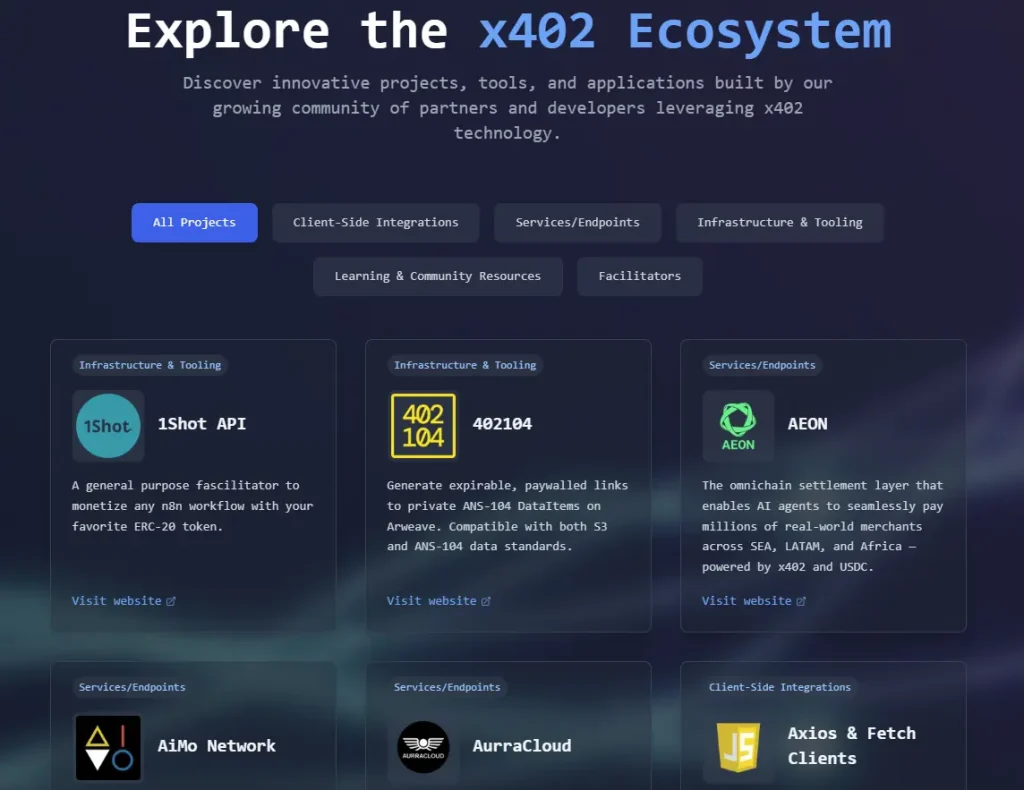
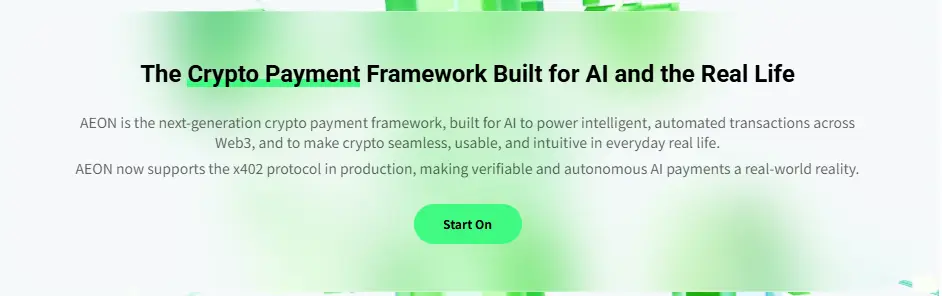
Even though x402 is new it already has a growing ecosystem of real world applications. Aeon uses x402 to allow AI agents to pay merchants across regions such as Southeast Asia and Latin America. AiMo Network uses x402 for pay per inference AI interactions. Pinata allows users to upload or fetch IPFS content with account free stablecoin payments. Heurist Deep Research enables users to pay for long form AI generated research reports through tiny on chain transactions.
There are also multiple developer tools including the x402.rs facilitator, PayAI multi network support, JavaScript libraries and Java SDKs. Furthermore, browser extensions and templates help developers integrate x402 without having to build full settlement logic themselves. This broad adoption shows how easily the payment protocol fits into real world environments and confirms that frictionless internet native payments are genuinely useful across industries.
How Developers Integrate X402 and Build Modern Payment Infrastructure with Facilitators
The roadmap for x402 focuses on expanding flexibility and accessibility. The team is working on improved multi token support, better integration with Solana SVM programs and additional payment schemes such as pay up to and streaming payments. A discovery layer known as Bazaar is being designed to help users and AI agents browse available x402 enabled services and view reputation or reliability scores.
In the long term the goal is to transition from a Coinbase hosted repository to a community governed model. The protocol is open source and the specification is public. As more contributors join the x402 ecosystem it will evolve into a fully decentralised internet native payment standard that aligns better with the broader vision of enabling open payment systems that work seamlessly with existing http and blockchain infrastructure.
Why X402 Could Become the Internet Native Payment Standard Beyond Traditional Payment Systems
The internet has always lacked a simple way to pay for resources directly over http while traditional payment systems rely on subscriptions, card details and user accounts. These systems do not work well for AI agents or autonomous clients that need to transact without human intervention. The x402 protocol fixes this by enabling real time on chain settlement and allows developers to monetise resources in a transparent way. It also allows clients to pay exactly for what they consume therefore enabling new programmatic and autonomous use cases that traditional payment systems cannot support.
Because it is simple, trustless, open source and designed for real world adoption x402 has the potential to become a foundational layer for internet native payments. It truly gives the web a reliable way to pay directly over http, something that content creators, developers, agents and AI models can all use without friction.
How to Start Using the X402
If you want to explore the x402 payment protocol we encourage you to visit the official documentation at x402.org
Furthermore, if you are a developer you can try a simple demo using Base Sepolia to see how clients transact using the 402 flow.
Thank you for reading the full article! For more beginner friendly research and deep dives into blockchain technology make sure to follow Simply Staking on X and stay updated with our latest insights.