









What happens when a new blockchain project sets out to make Web3 truly mainstream? That vision is becoming reality with the launch of Soneium blockchain, a public blockchain developed in partnership with Startale Labs, known for its blockchain expertise and work with Astar Network.
Soneium is a developer friendly blockchain that combines the security of Ethereum Layer 1 with the scalability of an Optimism Layer 2. It is designed to be faster, cheaper, and more accessible than Ethereum while staying fully connected to the wider crypto ecosystem. Its tagline, “Emotion. Creative. Go Mainstream,” captures the mission perfectly by making blockchain technology part of everyday life rather than a niche for experts.
At its heart, Soneium is an open network built for creators, communities, and developers. It is not just another blockchain. It is a complete Web3 ecosystem focused on entertainment, gaming, music, and culture, making blockchain technology easier and more engaging for everyone.
What Is Soneium and How Does It Fit into the World of Crypto?
Soneium is an Ethereum Layer 2 blockchain that was officially launched in January 2025. It is built with Optimism’s OP Stack and is part of the Superchain, which means that Soneium is an optimistic rollup that inherits security from Ethereum’s Layer 1 while executing transactions at a much lower cost. It is designed to be a public blockchain where anyone can participate and its mission is to leverage blockchain technology to empower developers and creators, building use cases that reach mainstream audiences.
In simpler terms, Soneium aims to connect Web2 familiarity with Web3 innovation. While many other projects and blockchains target existing crypto users, Soneium aims to bring in diverse businesses and millions of new users by making Web3 mainstream.
How Does the Soneium Testnet and Mainnet Work?
Think of Soneium like a fast lane on top of Ethereum. While Ethereum suffers from slow processing times and high transaction fees, Soneium processes transactions more efficiently while still anchoring security on Ethereum.
Here are some key features of how the Soneium blockchain functions:
- ETH as gas: Soneium uses Ethereum’s native asset ETH to pay for transaction fees. There is no separate Soneium token at present.
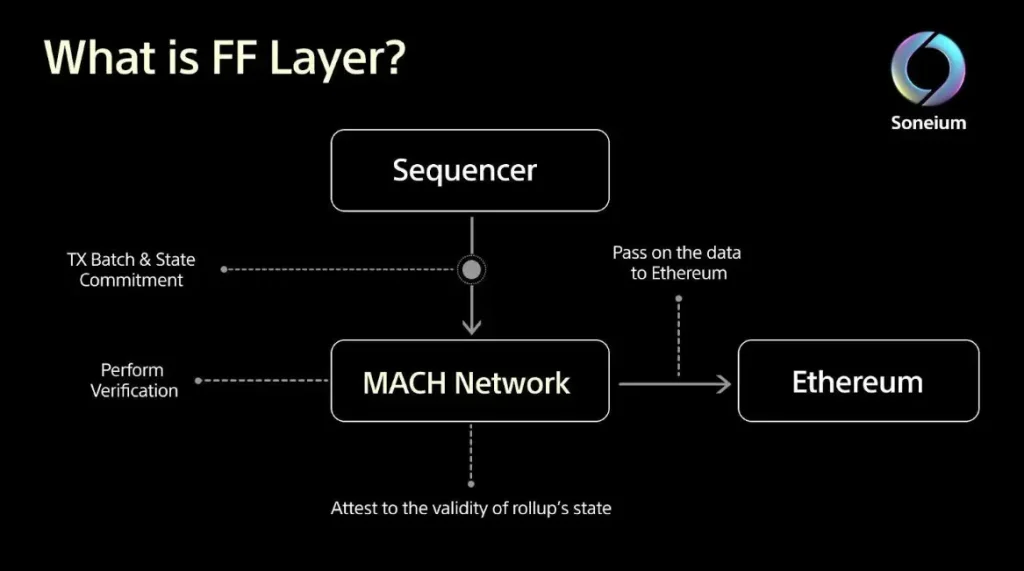
- OP Stack: By using Optimism’s OP Stack, Soneium is compatible with existing Ethereum tools and inherits the fraud proofs and sequencer design of other Optimism Layer 2 chains.
- Mainnet launch in January 2025: After running the Minato testnet since August 2024, the project went live. The testnet had already processed over 47 million transactions and onboarded more than 14 million wallets before mainnet launch.
- Fast Finality upgrade: Soneium is working with Astar, AltLayer, and EigenLayer on a modular fast finality solution that will reduce average block confirmation times to under 10 seconds. Considering Soneium’s vision and focus on use cases like gaming, social dApps, and DeFi, this is absolutely critical as such use cases require near instant confirmations.
Curious about the technology Soneium is built on? We got you covered! Read our guide to Optimism.
The Soneium Ecosystem: Block Solutions Labs, Stablecoins, Total Value Locked, and Use Cases
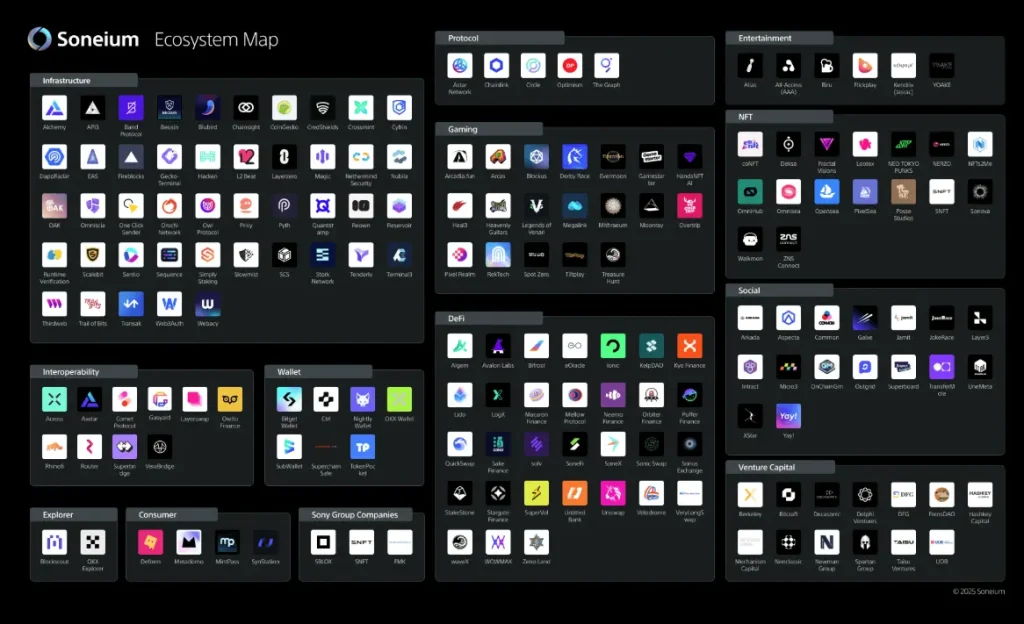
The Soneium blockchain launched with an impressive ecosystem, covering both infrastructure to the application layer.
- Infrastructure: Chainlink provides oracles, Alchemy delivers APIs for developers, Circle integrated USDC stablecoins, and The Graph powers blockchain data indexing.
- DeFi protocols: Aave, Uniswap, QuickSwap, and Velodrome have already deployed, bringing liquidity and TVL (total value locked) to the network.
- NFTs and entertainment: OpenSea launched support for Soneium NFTs. Sony’s (yes that Sony, one of the world’s biggest entertainment giants) own campaigns included Ghost in the Shell NFTs and Aibo themed Soulbound Tokens, which saw more than 40 million tokens minted onchain. Square Enix ran a campaign with its Symbiogenesis NFT game, while Sonova explored music NFTs to support artists.
- Mainstream adoption: Integration with the LINE Mini App means millions of users in Asia can now access Web3 services and dApps directly from their familiar chat app.
To support innovative projects, Sony Block Solutions Labs launched the Spark incubation program, which selected 32 teams from more than 1700 applicants. These teams received funding and mentorship to build diverse applications across DeFi, gaming, and creator tools.
Community engagement is another area where Soneium shines. Campaigns like Soneium Conquest and Assemble on Soneium onboarded hundreds of thousands of new users through quests and reward systems. Combined with its incubation support, this has created a developer friendly ecosystem where anyone can experiment with blockchain development.
What About the Token?
Unlike many new blockchains, Soneium is a Layer 2 without its own native token. Instead, it uses ETH for gas. This decision makes the blockchain simpler for users and avoids the confusion of new tokenomics.
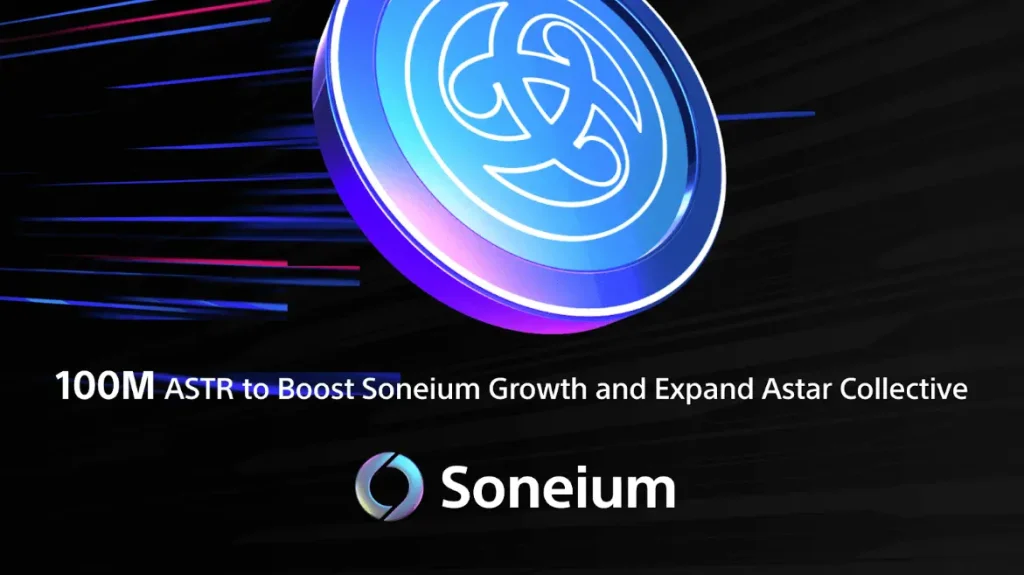
However, ASTR, the token from Astar Network, plays a big role in Soneium’s ecosystem. The Astar Foundation launched a campaign distributing 100 million ASTR as incentives for users to try Soneium applications, provide liquidity, and engage with smart contracts. ASTR is also used in the upcoming fast finality system alongside restaked ETH, providing security for the validator set.
This model is unusual in crypto but fits Sony’s compliance friendly strategy. By leveraging existing assets like ETH and ASTR, the project can grow its ecosystem without introducing a speculative token immediately.
Why Is Sony Building a Blockchain?
The Sony Block Solutions Lab has always combined creativity with technology. With Soneium, Sony’s vision is to fill the world with emotion by giving creators and communities a blockchain platform where they can connect directly with fans.
At its core, the project is compliance first. At mainnet launch, Soneium’s team blacklisted certain infringing smart contracts such as tokens using unauthorised trademarks. This type of decision reflects Sony’s commitment to protecting intellectual property, making the blockchain brand safe and attractive to diverse businesses.
Sony aims to decentralise slowly and carefully while ensuring that the network is permissionless and secure. For Sony, Soneium is not only about crypto innovation but about creating an open network that delivers real Web3 services people will actually use.
The Road Ahead: Faster Average Block Times and Future Growth
Soneium is still early, but the roadmap is ambitious.
- The Fast Finality upgrade will significantly improve processing speed and user experience, reducing average block confirmation times to sub 10 seconds.
- More incubator programs and community campaigns will expand developer activity and keep liquidity flowing across the ecosystem.
- New integrations with familiar IPs such as anime, games, and music are expected to drive adoption.
- Governance may evolve in the future, possibly allowing for more decentralised decision making, although no token or DAO has yet been confirmed.
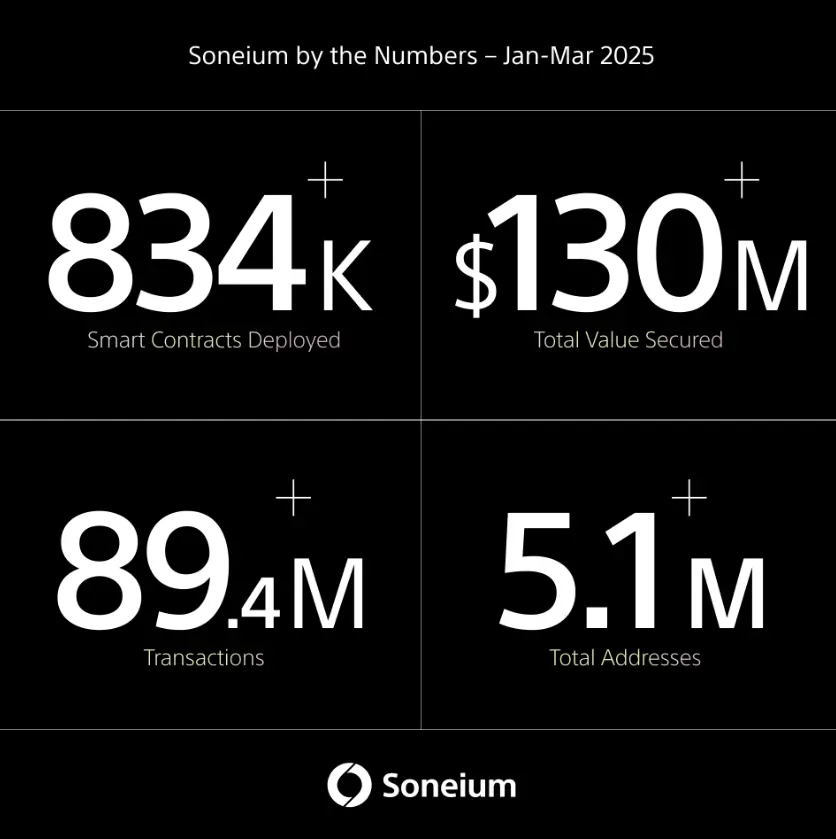
The early numbers are already impressive. Within months of launch, millions of addresses had been created, over 89 million transactions processed, and more than 834,000 smart contracts deployed. The network reached over 130 million dollars in TVL according to L2BEAT, showing strong early confidence from developers and users.
Conclusion
The Soneium blockchain is a bold experiment that blends cultural innovation with the security and scalability of Ethereum. Built with Optimism’s OP Stack and part of the Superchain, Soneium is a developer friendly Layer 2 blockchain that already supports a wide range of projects across DeFi, NFTs, and entertainment.
What sets Soneium apart is its mission to make Web3 accessible to everyone. From Ghost in the Shell NFTs to chat app integrations, the network’s use cases are designed to feel familiar, engaging, and easy to use. Supported by Startale Labs, Soneium has quickly become one of the most exciting networks to watch in 2025.
If you care about gaming, music, NFTs, or the future of Web3 services, now is a good time to explore Soneium, and if you enjoyed this article, make sure to follow Simply Staking on X for more insights into the projects shaping the future of Web3!